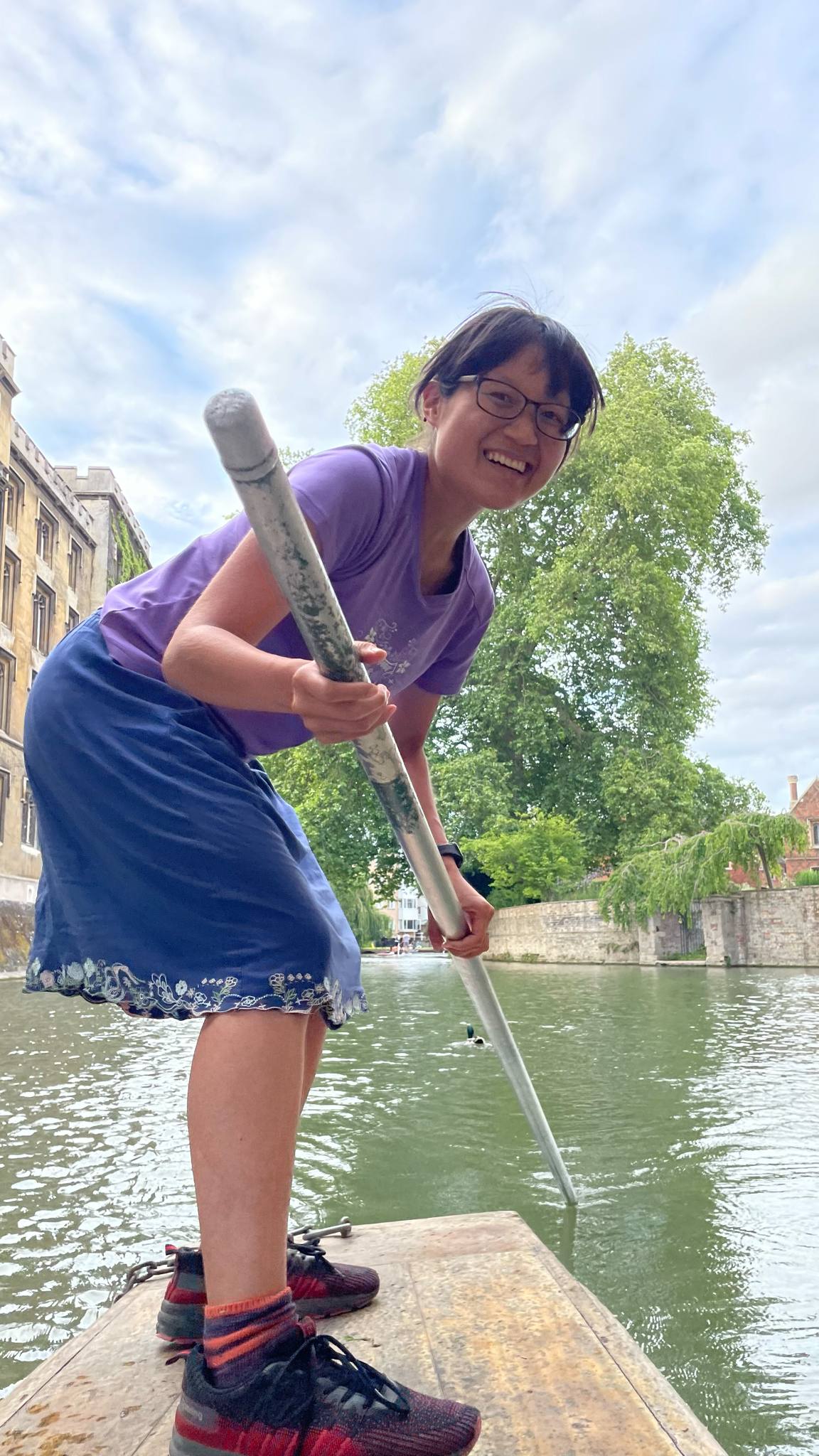
About
I am a PhD student in Theoretical Physics at the Cavendish Laboratory, University of Cambridge, supervised by Dr. Will Handley and Dr. Latham Boyle. My thesis is titled The CPT-Symmetric Universe and Bayesian Model Comparison.
My research investigates the CPT-Symmetric Universe — a minimal, unified framework proposing that the Big Bang was not a beginning from nothing, but a CPT (Charge, Parity, Time) mirror reflection. This creates a universe/anti-universe pair where time runs backward in the anti-universe relative to ours. Remarkably, this single symmetry assumption naturally explains the smoothness of the universe, the nature of dark matter, and dark energy, without needing complex additions to the standard model.
My doctoral work spans two main directions: (1) deriving the first theoretical predictions for quantized cosmic curvature ΩK and testing them against Planck CMB data via Bayesian analysis, and (2) investigating the quantum basis of CPT symmetry through Kähler-Dirac fermions — a generalization of the Dirac equation well-defined in curved spacetime. My future research aims to address the fermion doubling problem in lattice gauge theories, the origin of mass via a composite Higgs mechanism, and quantum gravity as an architect of cosmic structure.
Research Interests: CPT-Symmetric Universe · Theoretical Cosmology · Particle Physics · Kähler-Dirac Fermions · Bayesian Inference & Model Comparison · Lattice Field Theory · Quantum Gravity
Publications
CPT-Symmetric Kähler-Dirac Fermions
Submitted to Physical Review Letters, 2025
We quantize the Kähler-Dirac (KD) field across the CPT-symmetric universe/anti-universe pair and show that half the modes carry unphysical negative energies when considered in isolation. Quantizing fields jointly across both universes resolves this, and further reveals that CPT symmetry is not a freely imposed assumption, but a physical requirement — providing the quantum foundation for the entire CPT-symmetric cosmological framework.
CMB Constraints on Quantized Spatial Curvature ΩK in Globally CPT-Symmetric Universes
Physical Review D 113, 023546, 2025
Using Planck CMB data and Bayesian analysis, we constrain the quantized spatial curvature values predicted by globally CPT-symmetric universes. We find that the observationally preferred curvature aligns well with our theoretical predictions, providing compelling observational support for the CPT-symmetric cosmological model.
Predicting Spatial Curvature ΩK in Globally CPT-Symmetric Universes
Physical Review D 110, 103528, 2024
We derive the first theoretical predictions for quantized cosmic curvature ΩK from the CPT-symmetric universe framework. Just as a musical instrument supports only discrete frequencies, the periodic spacetime structure of a CPT-symmetric universe constrains the spatial curvature to specific quantized values — a falsifiable prediction directly testable against cosmological observations.
Spectral Energy Distributions of Dust and PAHs Based on the Evolution of Grain Size Distribution in Galaxies
Monthly Notices of the Royal Astronomical Society 499, 3046–3060, 2020
We model the spectral energy distributions (SEDs) of interstellar dust and polycyclic aromatic hydrocarbons (PAHs) in galaxies by tracking the full evolution of grain size distributions using dust evolution codes. Our models successfully reproduce observed galaxy SEDs across infrared wavelengths, providing a physically motivated framework for interpreting dust emission in star-forming galaxies.
Research Experience
CPT-Symmetric Universe Framework
Working with Dr. Latham Boyle (Perimeter Institute / Higgs Centre for Theoretical Physics) to investigate the physical properties of Kähler-Dirac fermions and understand their implications for the CPT-symmetric universe. This work provided the quantum-field-theoretic foundation for the model, showing that CPT symmetry is physically required rather than postulated.
Cosmological Model Building and Bayesian Inference
Theoretically predicted spatial curvature values in periodic CPT-symmetric universes and confronted these predictions against Planck Satellite CMB data using Bayesian inference. Key skills: Nested Sampling, Parameter Estimation, Model Selection, High-Performance Computing (HPC), and AI-integrated workflow optimization.
Numerical Relativity & Relativistic Vortices
Conducted analytical and numerical calculations on relativistic vortices and their interactions with black holes using GRChombo, a state-of-the-art numerical relativity code. This work formed my M.Sc. thesis: Relativistic Vortices and Numerical Relativity.
Selected Talks & Posters
- Talk: The CPT-Symmetric Universe: From Quantized Curvature to Kähler-Dirac Fermions — Theoretical Particle Physics & Cosmology (TPPC) Seminar, King's College London, London, UK (Mar 2026)
- Talk: Quantizing the Kähler-Dirac Field: A Theoretical Explanation for Tenet?! — Cambridge-LMU Cosmology Meeting, Munich, Germany (Sep 2025)
- Poster: Theoretical Prediction of Curvature ΩK in Periodic Universes — Cosmological Frontiers in Fundamental Physics, Paris, France (Jun 2025)
- Talk: Predicting Spatial Curvature ΩK in Globally CPT-Symmetric Universes — APS Joint March/April Meeting, Anaheim, California, USA (Mar 2025)
Contact
Email: wnd22@cam.ac.uk
Address: Department of Physics (Cavendish Laboratory), University of Cambridge, Cambridge, UK